
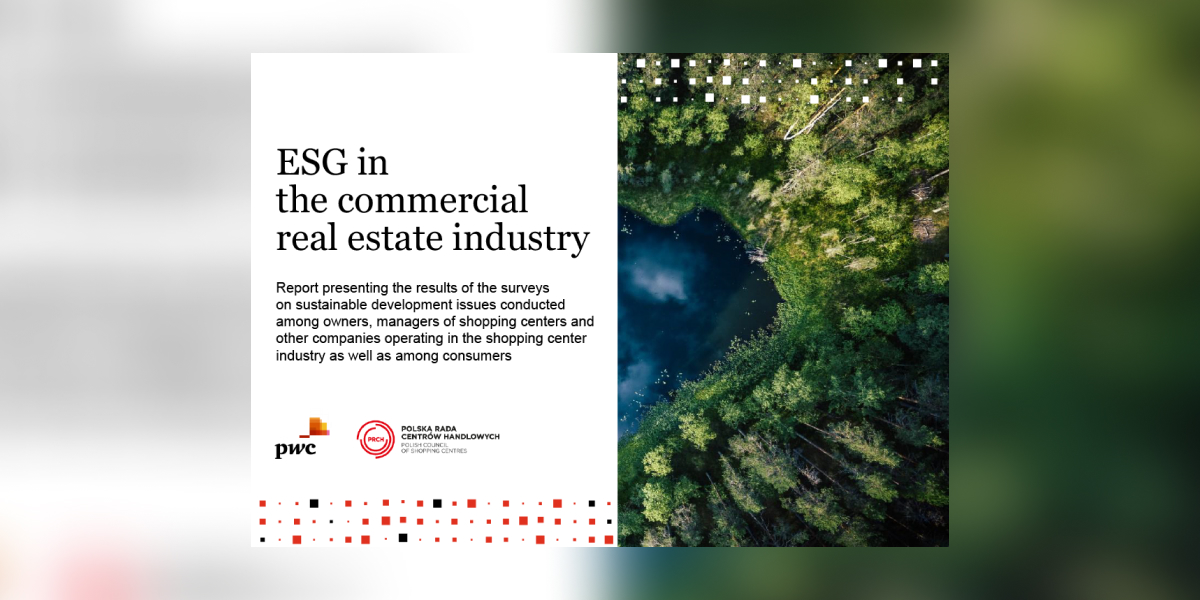
Are Polish shopping centre customers willing to pay more for eco-friendly solutions? Are shopping centre managers actually implementing ESG strategies, or just talking about them? The answers to these questions are found in the report „ESG in the commercial real estate industry”, prepared jointly by the Polish Council of Shopping Centres (PROH) and PwC. This report is unique in that it brings together two perspectives at once: the industry side (shopping centre owners and managers) and the consumer side (shopping centre customers).
What is this report?
The report is based on two independent studies conducted in 2021: an online survey among PROH members (carried out between 21 May and 1 June 2021) and a representative consumer survey using the CAWI method on a sample of 1,000 adult Poles, conducted by the Inquiry agency in September 2021. The publication is available in English and serves as a starting point for a broader PROH discussion on sustainability in the retail real estate sector.
Top 5 findings from the report
- 72% of shopping centre owners/managers confirm that their companies have a sustainability policy
- 85% confirm that their company’s (or group’s) strategy incorporates sustainability into day-to-day operations
- 57% of managers admit that tenants in their shopping centres show at least some interest in ESG issues
- 59% of consumers would be willing to switch to a different shopping centre if it implemented a sustainability policy
- 60% of consumers would agree to pay around 1 PLN extra per product if the shopping centre used only paper bags
What’s inside?
1. Introduction to ESG
The report explains what the E (Environmental), S (Social), and G (Governance) pillars are and why they are becoming increasingly important for the real estate sector. The authors note that buildings account for around one-third of global CO2 emissions, and that as much as three-quarters of Europe’s building stock is not energy efficient.
2. Regulatory Environment for Sustainability
An overview of key EU and global initiatives shaping the ESG framework – from the European Green Deal, through the UN 2030 Agenda, to the Paris Agreement. The report shows which areas of business activity are already covered by regulation: CO2 emission reduction, energy efficiency, responsible supply chains, and waste segregation.
3. Sustainability in the Retail Real Estate Sector
An analysis of how companies in the sector perceive their impact on the environment and society. As many as 91% of respondents believe companies should account for their impact on the natural environment, and 80% believe companies should limit profit-generating activities if they have a negative environmental impact.
4. Sustainability as Part of Corporate Strategy
The report shows that sustainability policy is most often embedded in operational strategy (85%), CSR (68%), and marketing activities (53%). Fewer than half of companies confirm that ESG policy is imposed top-down by headquarters.
5. Strategic Sustainability Actions by Companies
Data on resource-consumption monitoring – 84% of companies collect data on energy and water consumption, but only 28% conduct CO2 emission audits. The chapter includes expert commentary from Reesco Retail and Multi Poland on practical solutions (BMS systems, green energy procurement, GRESB certification).
6. Building Surroundings and Environmental Modernisation
An analysis of efforts to expand biologically active areas around shopping centres (43% of companies already doing so) and of modernising properties from an environmental perspective.
7. Priority Issues for Retail Real Estate Sustainability
Respondents identify waste reduction (82%) and sourcing energy from alternative sources (64%) as the top priorities, while reducing combustion-vehicle traffic ranks as the least important.
8. Tenants’ Approach to Sustainability
Data showing that tenants are increasingly asking about ESG solutions, confirmed by a comment from a CBRE expert, according to whom properties managed in line with a sustainability strategy lease up faster and more efficiently, with tenants willing to pay higher rent.
9. The Consumer Perspective
The most telling part of the report: although 85% of consumers believe shopping centres should act in favour of the environment, only 36% rate them as environmentally friendly, and as many as 67% say shopping centres communicate their environmental efforts too poorly. The report also outlines specific consumer expectations – from waste reduction, through greening the areas around buildings, to installing photovoltaic panels.
10. Best Practices and Market Data
The report closes with a list of proven practices already used in Polish shopping centres (EV charging stations, heat pumps, wildflower meadows, rooftop beehives, e-waste collection points) as well as basic data on the Polish retail real estate market for 2021, including on PROH itself – an organisation bringing together more than 180 companies accounting for 70% of retail space supply in Poland.
Who is this report for?
The report was prepared with the following readers in mind:
- shopping centre owners and managers, building or developing ESG strategies,
- CSR and sustainability departments at commercial real estate companies,
- retail chain tenants, assessing location attractiveness from an ESG perspective,
- investors and financial institutions, analysing ESG risk in real estate portfolios,
- marketing and communications specialists, planning sustainability-related campaigns.
Why is it worth downloading?
This is a rare opportunity to see the topic of ESG in retail from two sides at once – industry declarations and real consumer expectations. The report reveals a clear gap between what shopping centres are doing and what their customers actually see and value – an invaluable insight for both operational strategy and marketing communication.